
Commercial Lighting Audit & Maintenance Program
Recurring lighting inspections, repairs, and reporting designed to keep commercial properties ahead of outages, tenant complaints, and unexpected lighting issues.
On Target Contracting’s Commercial Lighting Audit & Maintenance Program is designed for property managers, building owners, facility teams, and multi-property portfolios that want lighting problems identified before tenants or customers have to report them.
Instead of waiting for a dark parking lot, failed exit sign, or interior lighting complaint to reach your desk, OTC routinely inspects the property, documents deficiencies, handles minor repairs when included in the service plan, and provides clear recommendations for anything requiring additional work.
The goal is simple: the problem becomes ours, and what reaches your desk is the solution.
Built for Property Managers
Managing commercial properties means dealing with dozens of small issues that compete for attention every day.
Lighting should not need to be one of them.
OTC’s lighting program gives property managers a recurring electrical partner who becomes familiar with:
-
The property
-
Fixture types
-
Lighting controls
-
Parking lot lighting
-
Emergency lighting
-
Access requirements
-
Previous repairs
-
Recurring problem areas
Over time, that property knowledge allows service to become faster and more proactive.
Instead of starting from zero on every call, OTC already knows what is installed and what has happened there before.
What We Inspect
A commercial lighting audit can include:
Interior Lighting
-
Offices
-
Corridors
-
Common areas
-
Restrooms
-
Stairwells
-
Lobbies
-
Breakrooms
-
Tenant-facing areas
Exterior & Site Lighting
-
Parking lot pole lights
-
Wall packs
-
Walkways
-
Building-mounted lighting
-
Site lighting
-
Sign lighting
Emergency & Exit Lighting
-
Emergency fixtures
-
Exit signs
-
Battery-backed equipment
-
Visible damage
-
Failed components
Lighting Controls
-
Photocells
-
Time clocks
-
Contactors
-
Occupancy sensors
-
Lighting-control devices
The exact inspection can be customized around the property.
Interior During the Day. Exterior When It Matters.
Some lighting problems are easy to identify during normal business hours.
Parking lot and exterior lighting are different.
OTC can inspect exterior lighting at night, or manually activate the lighting system during daytime service when appropriate, so failed fixtures and dark areas are actually identified.
A parking lot that looks fine at 2:00 PM can look completely different at 9:00 PM.
More Than an Inspection
The purpose of the program is not to create a list of problems and hand it back to the property manager.
When the service agreement allows, OTC can address minor lighting repairs during the scheduled visit.
Examples may include:
-
Failed lamps or fixtures
-
Photocells
-
GFCIs
-
Drivers
-
Ballasts
-
Minor control issues
-
Small electrical repairs
Larger repairs or capital improvements are documented and quoted separately.
This keeps small lighting problems from becoming separate service calls every time something fails.
Clear Reporting After Every Visit
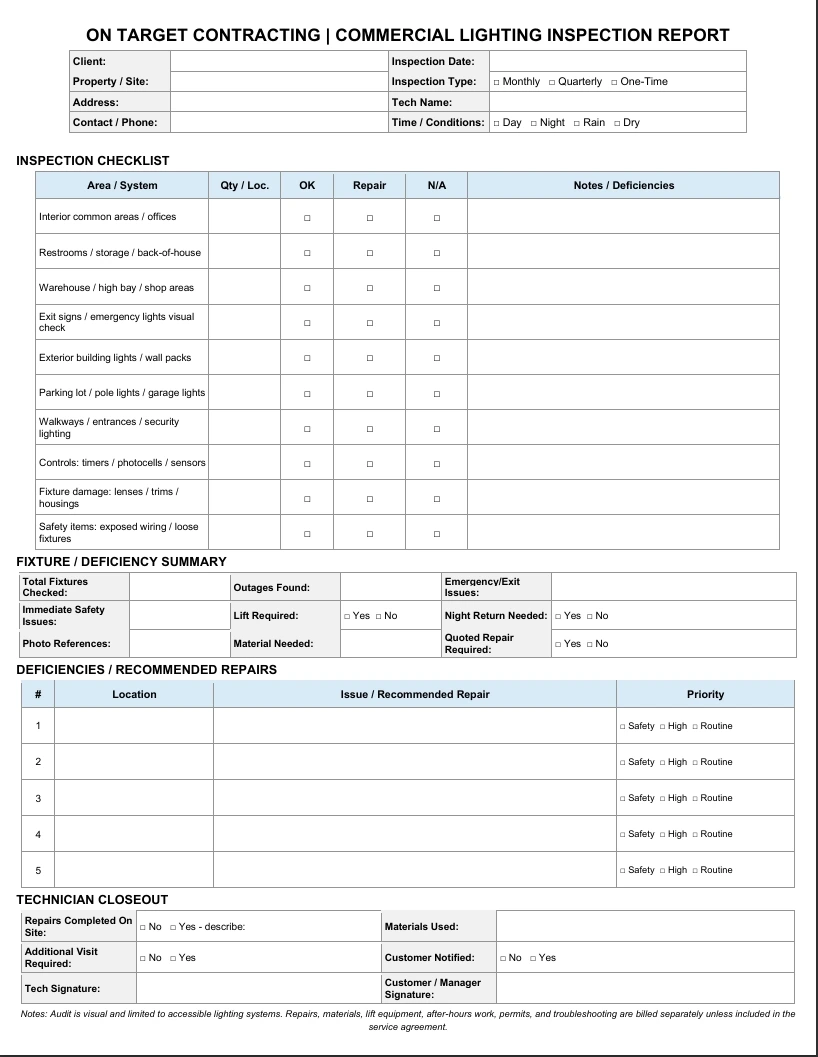
After the lighting audit, OTC provides documentation showing what was inspected, what was found, and what needs attention.
Reporting can include:
-
Property location
-
Fixture or equipment location
-
Photos
-
Deficiency description
-
Repairs completed
-
Materials used
-
Recommended repairs
-
Upgrade opportunities
The report should be useful to a property manager who is not an electrician.
You should be able to understand:
What is wrong?
Did OTC fix it?
If not, what needs to happen next?
Priority-Based Recommendations
Not every lighting issue deserves the same response.
OTC can organize recommendations into categories such as:
Urgent
Conditions that need immediate attention.
Repair Soon
Items that are currently operating but should be addressed before they become failures.
Capital Upgrade
Larger items that should be planned and budgeted for replacement or modernization.
Monitor
Aging or developing conditions that do not currently justify replacement.
This gives property managers a practical maintenance and capital-planning tool instead of an unorganized repair list.
Your Lighting Audit
Every scheduled visit follows a consistent inspection process so the property can be tracked over time.

Track the Property Over Time
The value of recurring maintenance increases with every visit.
OTC can track:
-
Fixture types
-
Repeated failures
-
Previous repairs
-
Control-system issues
-
Aging fixtures
-
Recommended replacements
-
Capital improvements
If one parking lot pole repeatedly requires repair, or a particular fixture type begins failing across the property, that trend becomes visible.
That allows the property manager to make a planned decision instead of continuing to pay for isolated repairs indefinitely.
Lighting Inventory
For recurring clients, OTC can build a working fixture and lighting-system inventory.
That can include information such as:
-
Fixture type
-
Location
-
Lamp/LED type
-
Driver or ballast information
-
Exterior control type
-
Common replacement components
This allows technicians to arrive better prepared for future service.
Multi-Property Portfolios
The program becomes especially valuable for property management companies responsible for multiple locations.
OTC can maintain lighting history by property while providing consistent service across the portfolio.
For example, a property manager responsible for 20 buildings can see:
-
Which properties have open lighting issues
-
Which repairs were completed
-
Which locations have aging equipment
-
Which properties need capital upgrades
-
Which recurring failures should be addressed differently
Properties can be added or removed as the portfolio changes.
Who This Program Is Built For
The Commercial Lighting Audit & Maintenance Program is a strong fit for:
-
Commercial property management companies
-
Office complexes
-
Retail centers
-
Strip malls
-
Shopping centers
-
Hotels
-
Multifamily common areas
-
Warehouse portfolios
-
Industrial properties
-
Large commercial campuses
-
Owners managing multiple properties
Properties with large amounts of interior and exterior lighting gain the most value because failures are difficult for one maintenance person to continuously monitor.
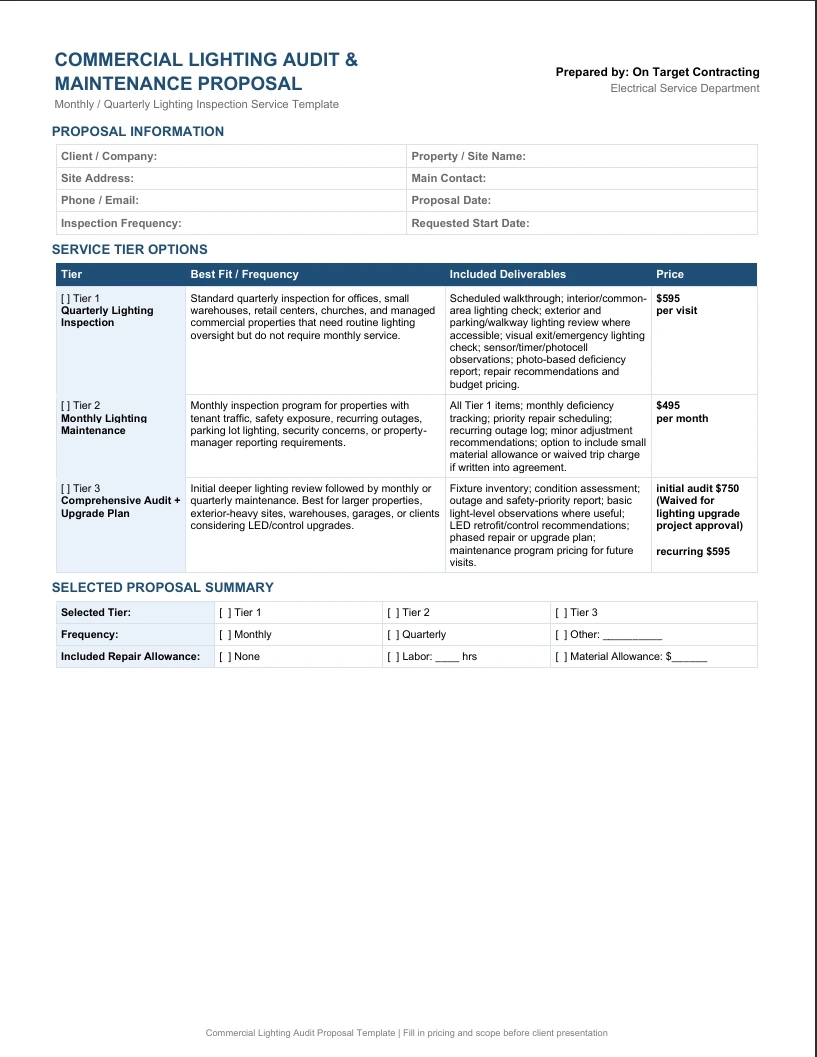
Monthly & Quarterly Programs
The inspection schedule can be matched to the property.
Monthly Program
Best for larger properties, higher-end assets, properties with substantial exterior lighting, and buildings where tenant experience matters.
A monthly program can include scheduled inspection time and minor maintenance labor, with materials and larger repairs handled separately according to the service agreement.
Quarterly Program
A good option for properties that need recurring oversight but do not require monthly service.
Quarterly visits focus on identifying deficiencies, documenting conditions, and developing repair recommendations.
Why Property Managers Use the Program
Without recurring inspection, the normal lighting-maintenance process looks like this:
Fixture fails → Tenant notices → Tenant contacts property manager → Property manager contacts vendor → Vendor schedules visit → Problem gets repaired
The OTC program changes that sequence:
OTC inspects → OTC identifies problem → OTC repairs or documents it → Property manager receives the solution
That removes unnecessary steps from the property manager’s day.
Let Us Own the Lighting Problems
If you manage one commercial property or an entire portfolio, OTC can build a recurring lighting audit and maintenance program around your buildings. The objective is simple: Find the problem before your tenant does. Fix what can be fixed. Document what needs attention. Give you a clear plan for everything else.
Get Your Proposal Now!